
The Instrument
The Guzheng
China's ancient zither — two thousand years of music in twenty-one strings.
A Living History
2,500 Years of Song
The Guzheng (古筝, pronounced "goo-jung") has been central to Chinese music for over two and a half millennia. Its earliest ancestors appeared during the Warring States period — around 475–221 BCE — when it was known simply as "zheng." Over the centuries, it evolved from a five-string instrument to the 21-string version we know today.
During the Tang Dynasty (618–907 CE), the Guzheng reached the height of its cultural prestige. Court musicians played it at imperial banquets, and poets wrote verses inspired by its sound. It spread along the Silk Road to neighboring countries, where it became the ancestor of instruments like the Japanese koto, the Korean gayageum, and the Mongolian yatga.
Today, the Guzheng is one of the most widely studied instruments in China and among Chinese communities worldwide. Millions of students — from young children to adults — learn to play.
How It Works
The Structure of the Guzheng
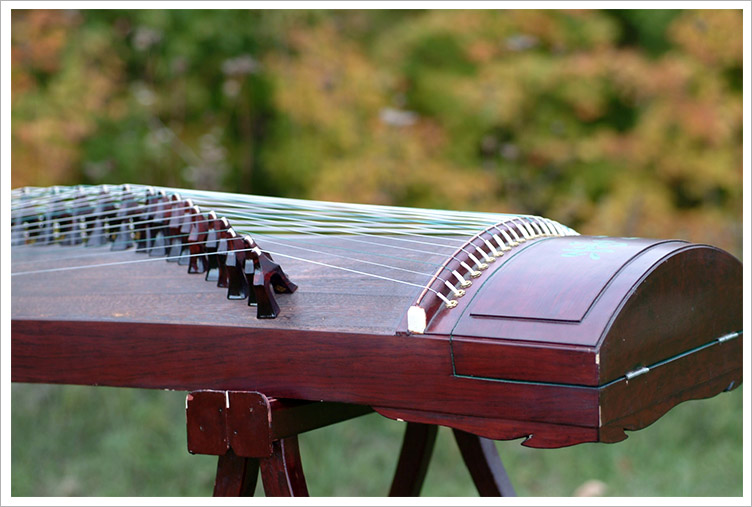
A Guzheng is a large zither — about 1.6 meters (5 feet) long — crafted from wood. Its 21 steel strings are each suspended over a movable bridge, which allows the player to tune individual strings to different pitches.
Players wear finger picks on the right hand to pluck the strings, while the left hand presses down on the strings to the left of the bridges to bend notes for vibrato and sliding notes.
This enables several techniques that allow the Guzheng to mimic sounds such as birdsong and flowing water.
Come Hear Us Perform
We'd love to bring Celestial 21 to your event, school, or community gathering. Reach out to learn more.
Book a Performance